Why the Manali to Leh Ladakh Road Trip Feels Like a Once-in-a-Lifetime Journe
Some road trips are simply about reaching a destination.
The Manali to Leh Ladakh road trip is different.
This is the kind of journey people talk about years later—the one where every turn feels cinematic, every stop feels unreal, and every difficult moment somehow becomes part of the story.
You begin in the lush green valleys of Himachal Pradesh, surrounded by pine forests, rivers, cafés, and mountain towns. A few hours later, the scenery changes completely. Trees slowly disappear, roads become rougher, and the mountains begin looking larger, quieter, and more dramatic.
By the time you enter Ladakh, it almost feels like you have left India and arrived on another planet.
That dramatic shift is what makes this route unforgettable.
For bikers, photographers, backpackers, and road-trip lovers, the Manali-Leh Highway is not just a route—it is an experience people dream about for years.
But there is something important many first-time travelers underestimate:
This trip demands preparation.
The roads can be unpredictable, oxygen levels drop quickly, weather changes suddenly, and fuel stations are extremely limited. A little planning makes the difference between an unforgettable adventure and an exhausting mistake.
That is exactly why this guide exists.
In this complete Manali to Leh Ladakh road trip guide, you will discover:
- The perfect 3-day itinerary
- Updated 2026 travel costs
- Fuel and accommodation tips
- AMS (Acute Mountain Sickness) prevention
- Permit details
- Packing essentials
- Safety advice
- Common mistakes to avoid
- Frequently asked questions
If planned properly, this can easily become one of the greatest journeys of your life.
Why is the Manali-Leh Highway So Famous?
Very few roads in the world feel this dramatic.
What makes the Manali to Leh road trip special is how quickly the landscape transforms.
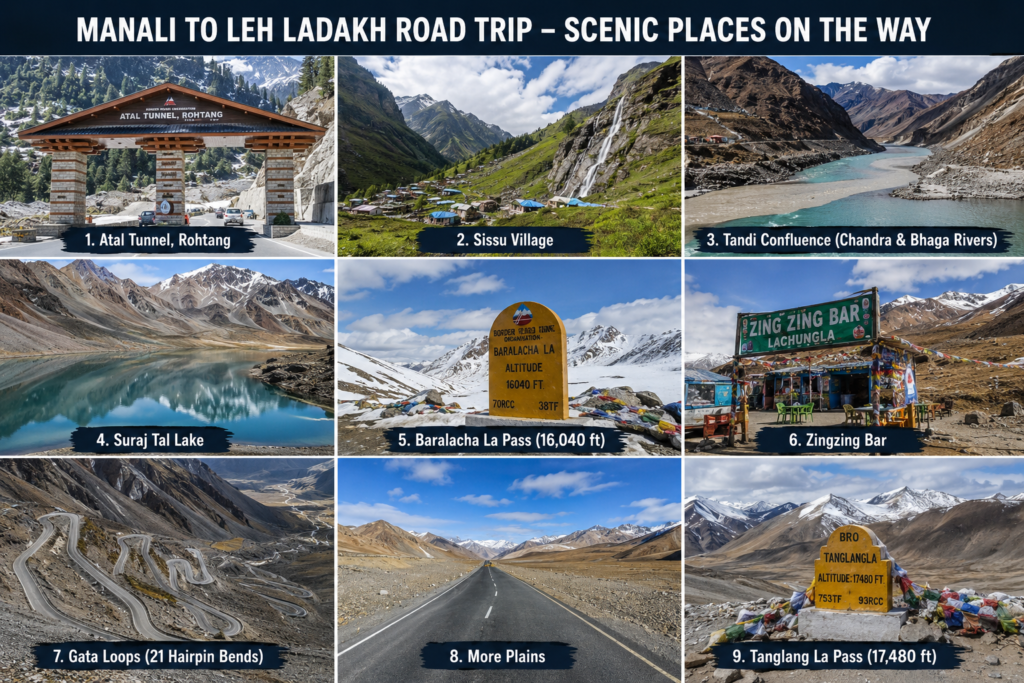
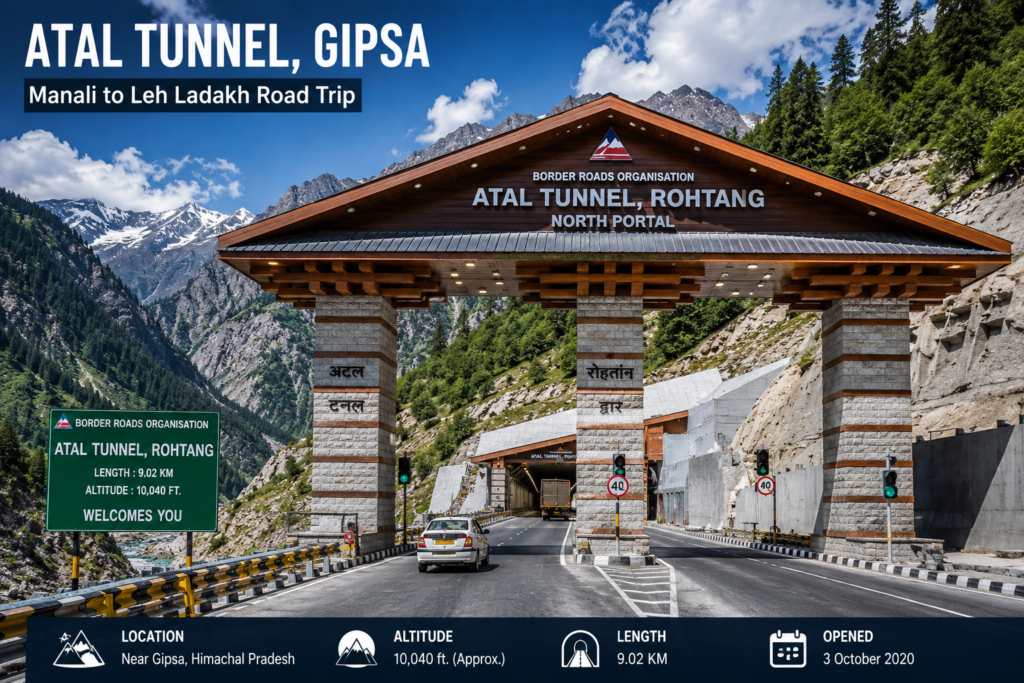
The journey begins in the green beauty of Himachal Pradesh. You cross rivers, forests, and mountain villages before entering the famous Atal Tunnel, which cuts directly through the mountains and completely changes the scenery.
Once you exit the tunnel, everything starts feeling different.
The roads become emptier.
The mountains look rougher.
And the silence slowly replaces city noise.
Hours later, you find yourself surrounded by barren valleys, snow-covered peaks, and endless mountain roads stretching into the distance.
There are moments on this trip when you naturally stop your bike or car, remove your helmet, and simply stand there without saying anything.
No traffic noise.
No distractions.
Just mountains and silence.
It is difficult to explain that feeling until you experience it yourself.
Important Travel Information You Should Know Before Starting
Before beginning the trip, there are a few important things every traveler should know.
| Travel Information | Details |
| Total Distance | Around 470 km |
| Recommended Duration | 3 Days Minimum |
| Best Time to Visit | June to September |
| Highest Point | Tanglang La Pass (17,480 ft) |
| Last Major Fuel Station | Tandi |
| Network Availability | Mostly postpaid SIM cards work |
One of the biggest mistakes travelers make is trying to complete the journey in a single day.
Technically, yes—it is possible.
But realistically, it is exhausting and risky.
Long hours of driving at high altitude, rough mountain roads, and changing weather conditions can drain your energy much faster than expected.
More importantly, your body does not get enough time to adjust to the altitude.
This increases the chances of Acute Mountain Sickness (AMS).
A 3-day itinerary is considered the safest and smartest option because it gives your body time to acclimatize while also allowing you to actually enjoy the route instead of rushing through it.
And trust me—
This is not a journey you want to rush.
Perfect 3-Day Manali to Leh Ladakh Itinerary
Day 1: Manali to Jispa via Atal Tunnel
Distance: Around 140 km
Drive Time: Approximately 5–6 hours
Your journey officially begins from Manali, one of Himachal Pradesh’s most popular mountain destinations.
Most travelers now prefer the Atal Tunnel route, which has made the journey significantly smoother compared to the older Rohtang Pass road.
Stretching more than 9 kilometers, the tunnel cuts through the mountain and saves several hours of difficult driving.
But the real adventure begins after you exit it.
The scenery changes almost instantly.
The lush green valleys slowly disappear behind you, rough mountain terrain begins to take over, and suddenly the trip starts feeling far more adventurous.
The roads feel quieter.
The air feels colder.
And for the first time, you realize—
The Ladakh journey has truly begun.
First Stop: Sissu
One of the first scenic stops after crossing the tunnel is Sissu, a peaceful Himalayan village surrounded by waterfalls and mountain views.
Many travelers stop here for tea, breakfast, or simply to take photographs.
It is one of those places where you naturally feel like slowing down for a while.
The calm atmosphere makes it a perfect break before heading deeper into the mountains.
The Most Important Stop of the Entire Trip: Tandi Fuel Station
If there is one stop you absolutely should not ignore, it is Tandi.
Why?
Because this is the last major petrol pump before Leh.
The next fuel station comes after a very long stretch of highway, so even if your tank still looks half full—refill it completely.
Many experienced riders also carry extra fuel for additional safety.
Skipping fuel at Tandi is one of the most common mistakes first-time travelers make.
Tandi Confluence – A Beautiful Hidden Stop
Near Tandi, you can also witness the meeting point of the Chandra and Bhaga rivers.
Together, these rivers eventually form the famous Chenab River.
It may not always appear in Instagram reels or travel vlogs, but it is one of those surprisingly peaceful spots worth stopping for.
Watching rivers merge while giant mountains stand around you creates a kind of calm that photographs rarely capture properly.
Why Spending the Night in Jispa is the Smartest Choice
After a comfortable drive, you finally arrive at Jispa, a peaceful riverside village sitting at around 10,500 feet.
Many travelers try to push farther and stay directly at Sarchu on the first day.
That sounds faster.
But it is rarely smarter.
Jispa sits at a lower altitude, which gives your body valuable time to slowly adjust. This greatly reduces the chances of altitude sickness later in the trip.
And honestly—
Jispa feels worth slowing down for.
The evenings here are incredibly peaceful.
Cold mountain air.
A river flowing quietly nearby.
Complete silence.
And skies full of stars brighter than most city dwellers ever get to see.
After a long drive, it feels like the perfect place to rest before heading into higher altitude the next morning.
Approximate Day 1 Cost
| Expense | Estimated Cost |
| Fuel | ₹1,500 – ₹3,000 |
| Food | ₹300 – ₹800 |
| Stay in Jispa | ₹800 – ₹3,500 |
Day 1 Travel Tip
Try to leave Manali before 6 AM.
Starting early helps you avoid traffic, gives you more daylight for sightseeing, and reduces the chances of dealing with stronger water crossings caused by glacier melt later in the day.
Day 2: Jispa to Sarchu — Where the Real Adventure Begins
Distance: Around 110 km
Drive Time: Approximately 5–6 hours
If Day 1 feels exciting, Day 2 feels unforgettable.
This is where the road trip truly begins testing you.
The comfortable valleys slowly disappear, oxygen levels start dropping, and the scenery transforms into something far wilder and more dramatic.
The roads feel emptier.
Villages become rare.
And suddenly, the mountains stop feeling like scenery and start feeling enormous.
This stretch of the Manali-Leh Highway feels raw, remote, and surprisingly humbling.
It is also where many travelers realize this is far more than just a road trip.
It feels like an expedition.
Deepak Tal — A Quiet Stop Worth Taking
One of the first beautiful stops on Day 2 is Deepak Tal, a peaceful high-altitude lake surrounded by rocky mountains.
The water here often appears perfectly still, reflecting the sky and nearby peaks like glass.
Most travelers stop briefly for tea, photographs, or simply a moment of silence before continuing the climb.
Early mornings here feel especially magical.
Cold air.
Empty roads.
And mountains that somehow look even larger in complete silence.
It is a small stop—but one that stays in your memory
Suraj Tal — One of the Most Beautiful Stops on the Entire Highway
As you continue climbing toward Baralacha La Pass, the landscape becomes harsher and colder.
Then suddenly—
You reach Suraj Tal.
And honestly, photographs rarely do justice to this place.
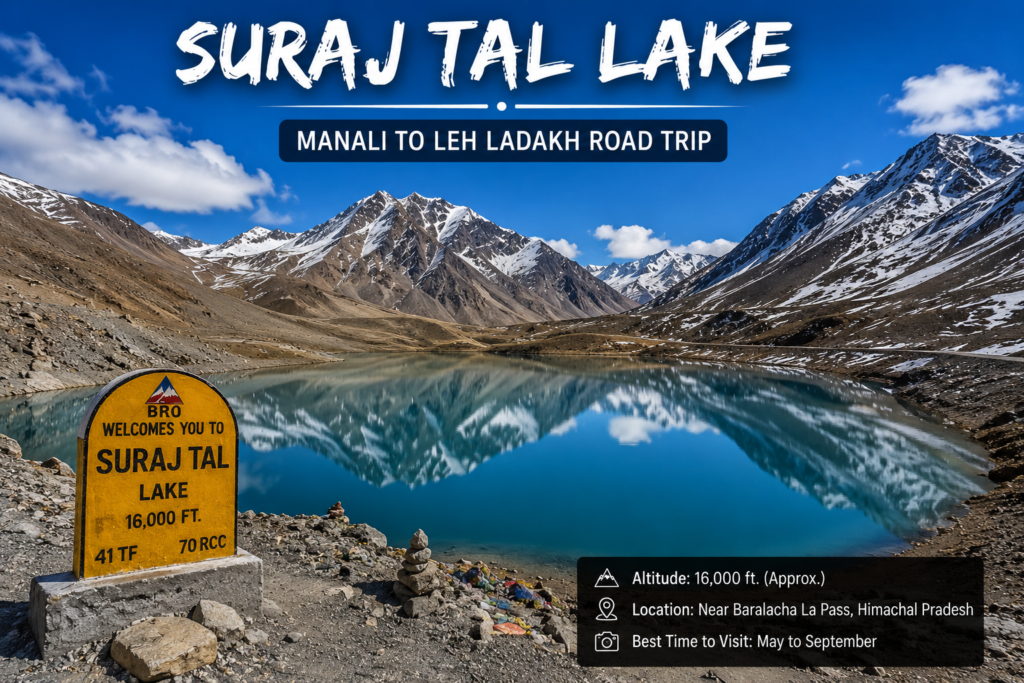
Located at nearly 16,000 feet, Suraj Tal is one of the highest lakes in India.
Surrounded by rugged mountains and freezing winds, the lake often looks impossibly still beneath a deep blue sky.
The first thing most people notice here is the silence.
No traffic noise.
No crowds.
Just cold air and giant mountains stretching endlessly around you.
Standing here often feels strangely emotional.
You suddenly realize how far you have already traveled from everyday life.
It becomes one of those moments that quietly stays with you long after the trip ends.
But there is one important thing to remember:
Do not stay too long.
The oxygen level here is much lower, and some travelers start experiencing headaches or slight dizziness.
Enjoy the view, take photographs, and continue moving steadily.
Crossing Baralacha La Pass
Soon after Suraj Tal, you cross the legendary Baralacha La Pass, one of the most important mountain passes on the route.
Standing at around 16,040 feet, this section often feels freezing—even during peak summer.
Depending on weather conditions, you may still see snow resting along the roadside.
Clouds move quickly here.
Weather changes fast.
And temperatures can suddenly drop without warning.
That unpredictability is part of what makes this journey feel exciting.
Take a short break if needed, breathe carefully, and continue driving at a comfortable pace.
At this altitude, rushing never helps.
Zingzing Bar — The Famous Mountain Tea Stop
Despite the unusual name, Zingzing Bar is one of the most well-known stops among bikers and road trippers.
Do not expect cafés or fancy restaurants.
This place is simple.
You will mostly find roadside tents serving hot tea, Maggi, omelets, and basic meals.
But after hours of mountain driving, even a simple cup of tea somehow tastes unforgettable.
That is one strange thing about mountain travel—
The simplest moments often become the best memories.
Arriving in Sarchu
By evening, you finally reach Sarchu, one of the most important overnight stops on the highway.
Located at roughly 14,000 feet, Sarchu sits near the border between Himachal Pradesh and Ladakh.
The scenery here feels completely different from anything earlier in the trip.
Wide-open valleys stretch endlessly in every direction.
Cold winds move through the camps.
And temperatures begin dropping quickly after sunset.
Unlike traditional hotels, most stays here are tent camps.
The facilities are basic.
But somehow, that becomes part of the charm.
At night, the sky often looks unreal.
Because there is almost no city light pollution, the stars appear incredibly bright—sometimes brighter than many people have ever seen.
For many travelers, this becomes one of the most memorable nights of the journey.
A Quick Reality Check About Staying in Sarchu
Sarchu is beautiful.
But it is also where many travelers first feel the effects of high altitude.
You may experience:
- Mild headache
- Fatigue
- Slight dizziness
- Difficulty sleeping
This is fairly common.
Your body is adjusting to thinner oxygen.
The best thing you can do is rest properly, stay hydrated, and avoid alcohol or smoking.
Mild discomfort is usually manageable.
But if symptoms become severe—especially breathing difficulty, confusion, or worsening nausea—seek medical help immediately.
There are army and medical transit camps nearby that assist travelers in emergencies.
Approximate Day 2 Cost
| Expense | Estimated Cost |
| Food & Tea Stops | ₹400 – ₹900 |
| Tent Stay in Sarchu | ₹1,000 – ₹4,500 |
| Snacks & Essentials | ₹300 – ₹700 |
Day 2 Travel Tip
Try to reach Sarchu before sunset.
Mountain roads become harder to navigate in darkness, temperatures fall quickly, and visibility becomes unpredictable.
An early arrival also gives your body extra time to adjust to the altitude before the toughest day of the journey.
Day 3: Sarchu to Leh — The Toughest Yet Most Rewarding Stretch
Distance: Around 250 km
Drive Time: Approximately 9–10 hours
Day 3 is long.
Very long.
But it is also the most rewarding part of the entire trip.
You wake up in freezing weather, drink hot tea while surrounded by mountains, and prepare for the final push toward Leh.
This stretch brings some of the most iconic places on the Manali to Leh road trip.
And trust me—
Many of them feel even more surreal in real life than they look online.
Gata Loops — The Legendary Hairpin Road
One of the most iconic sections of the journey is the famous Gata Loops.
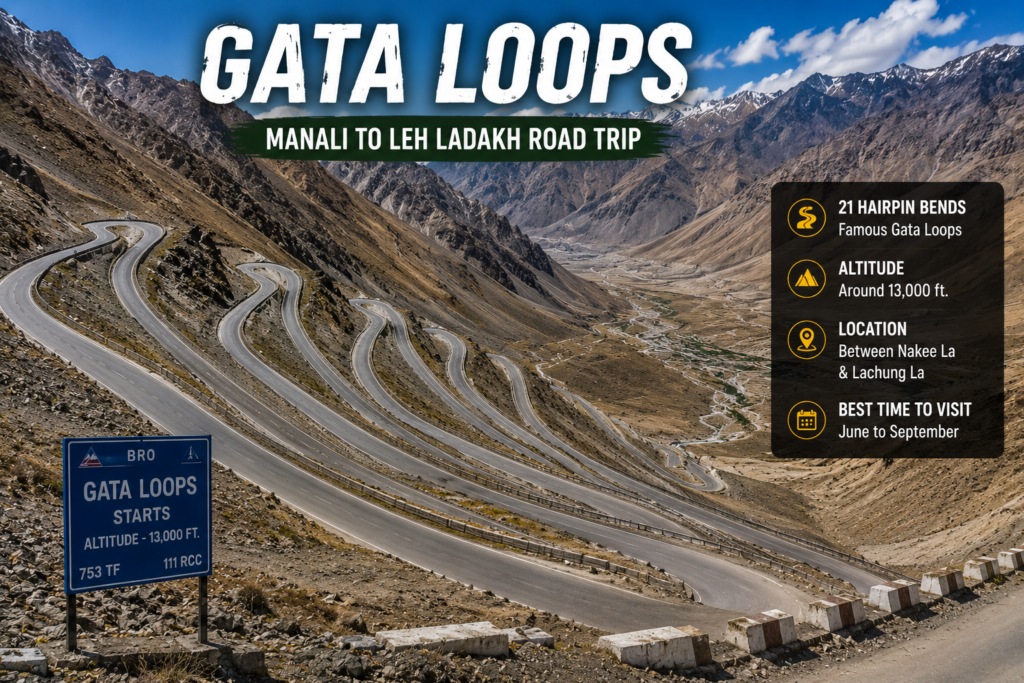
This stretch consists of 21 sharp hairpin bends, stacked one above another as the road climbs steeply into the mountains.
From a distance, the road looks like a ribbon twisting through giant cliffs.
Driving here feels exciting and slightly intimidating at the same time.
Each turn reveals another mountain view.
Each climb makes the roads below look smaller.
And somewhere in between, you begin realizing how far you have already come.
For bikers especially, this stretch feels unforgettable.
Crossing Nakee La and Lachung La
After Gata Loops, the road continues toward Nakee La and Lachung La, two important mountain passes on the highway.
The roads here can feel rough, windy, and physically tiring.
By this stage, fatigue is normal.
Take breaks whenever needed.
Drink water regularly.
And avoid rushing.
At high altitude, patience matters far more than speed.
Pang — A Much-Needed Break Stop
Before the final stretch, many travelers stop at Pang.
This is one of the better places on the route to eat, stretch, and take a short rest.
The setup is basic.
Mostly roadside tents and small eateries.
But after hours of mountain driving, even simple food tastes unexpectedly comforting.
Sometimes, a hot meal in freezing weather feels better than luxury.
More Plains — The Most Unreal Stretch of the Entire Journey
After hours of mountain roads, sharp bends, and rocky terrain, something unexpected happens.
The landscape suddenly opens up.
You enter the legendary More Plains.
And honestly—
It does not feel real the first time you see it.
Instead of steep mountain roads, you suddenly find yourself driving across a massive open plateau stretching for nearly 40 kilometers at an altitude of over 15,000 feet.
The road feels endless.
Mountains surround you from every side.
And for the first time in days, everything suddenly feels wide open.
Many travelers call this one of the most beautiful stretches of Ladakh.
Not because it is dramatic.
But because it feels strangely peaceful.
After hours of climbing roads and mountain passes, More Plains almost feels like the mountains finally allowing you to breathe.
This is one of those sections where you naturally want to slow down, stop the vehicle, and simply look around for a moment.
Tanglang La — The Final Mountain Challenge
Before reaching Leh, there is still one final challenge waiting.
Tanglang La Pass.
Standing at around 17,480 feet, it is among the highest motorable roads in the world.
By now, your body feels the altitude.
You are tired.
Your vehicle has already worked hard.
But somehow, crossing Tanglang La feels different.
Special.
Because deep down, you know—
You are close.
Very close.
And once you begin descending, something changes.
Breathing feels easier.
The roads slowly improve.
And eventually, the landscapes around Leh begin appearing in the distance.
After days of mountains, freezing winds, rough roads, and long hours of driving—
You finally arrive.
The feeling is difficult to describe.
Part relief.
Part excitement.
But mostly—
A quiet feeling of accomplishment.
Because this is not a journey you simply complete.
It is one you earn.
Manali to Leh Ladakh Road Trip Cost (2026)
One of the first questions travelers ask before planning this journey is:
“How much does a Manali to Leh Ladakh road trip cost?”
The honest answer?
It depends on how you travel.
A solo biker staying in budget camps and eating at local dhabas will spend much less than a group traveling in an SUV with comfortable stays.
Still, having an estimated budget makes planning much easier.
Here is a realistic 2026 travel cost estimate for a 3-day Manali to Leh road trip.
| Expense Category | Budget Travel | Mid-Range Travel |
| Fuel | ₹3,500 – ₹5,000 | ₹7,000 – ₹10,000 |
| Stay | ₹800 – ₹2,000/night | ₹3,500 – ₹6,000/night |
| Food | ₹500 – ₹1,000/day | ₹1,500 – ₹2,500/day |
| Bike Rental | ₹1,200 – ₹2,000/day | ₹3,000 – ₹5,000/day |
| Permits & Miscellaneous | ₹400 – ₹800 | ₹800 – ₹1,500 |
On average:
- Budget traveler: ₹12,000 – ₹20,000
- Mid-range trip: ₹25,000 – ₹40,000+
- Comfort/luxury travel: ₹50,000+
One important tip—
Always carry extra emergency cash.
Remote ATMs sometimes stop working, digital payments fail in weak network zones, and sudden weather changes occasionally force travelers to stay an extra night.
A backup budget reduces unnecessary stress.
Acute Mountain Sickness (AMS): The Biggest Challenge of This Journey
Most people think the hardest part of this trip is the road.
It is not.
The real challenge is the altitude.
During this journey, you climb from around 6,700 feet in Manali to mountain passes crossing 17,000+ feet within a short period.
That rapid altitude gain can affect almost anyone.
Even fit and experienced travelers sometimes struggle.
Common Symptoms of AMS
Mild symptoms are common and usually improve with rest.
You may notice:
- Headache
- Dizziness
- Mild nausea
- Fatigue
- Difficulty sleeping
These signs usually mean your body is adjusting to lower oxygen levels.
The mistake many travelers make is ignoring symptoms and continuing upward too quickly.
How to Reduce the Risk of AMS
The good news?
Most altitude problems are preventable.
The biggest rule is simple:
Do not rush the trip.
This is exactly why spending the first night in Jispa works so well. It gives your body valuable time to slowly adapt before reaching higher altitude.
Hydration also matters more than most people realize.
Drink enough water, avoid alcohol during transit, and eat lighter meals rather than heavy oily food.
Simple meals usually feel easier on the body at high altitude.
And if symptoms ever become severe—especially breathing difficulty or confusion—seek medical help immediately.
Never try to “push through” serious altitude sickness.
What to Pack for the Manali to Leh Road Trip
Packing smartly makes this trip far easier.
Ladakh weather changes quickly.
The same day may feel sunny in the afternoon and freezing by evening.
Instead of overpacking, focus on essentials.
Warm layers work better than carrying bulky luggage.
A good winter jacket, thermals, gloves, sunglasses, comfortable shoes, and woolen socks make a huge difference.
You should also keep:
- Power bank
- Offline maps
- Personal medicines
- First aid kit
- Snacks
- Water bottles
- Charger cables
Most importantly—
Keep these items easily accessible.
You do not want to unpack bags every few hours while standing on cold mountain roads.
Do You Need Permits for the Manali-Leh Highway?
This is one of the most common questions travelers ask.
If you are traveling through the Atal Tunnel route, you generally do not need a Rohtang Permit.
However, road rules occasionally change depending on weather and local administration, so checking current updates before departure is always a smart idea.
Once you reach Leh, things become different.
You will need an Inner Line Permit (ILP) for restricted areas such as:
- Pangong Lake
- Nubra Valley
- Tso Moriri
- Hanle
Most travelers apply online or arrange permits through local travel agents in Leh.
The process is usually straightforward.
Emergency Contact Directory & Crisis Support
Mountain travel always comes with uncertainty.
Road blockages, landslides, altitude sickness, punctures, and sudden weather changes are all part of the reality of the Manali to Leh Ladakh road trip.
And because mobile signal often disappears for long stretches, saving important information offline before starting the journey is always a smart decision.
Medical Help Along the Route
If someone experiences severe symptoms of Acute Mountain Sickness (AMS), Keylong is one of the most reliable places for emergency medical support during the journey.
There are also Army medical transit camps near Sarchu and Pang, where travelers sometimes receive oxygen support and emergency assistance during serious altitude-related situations.
If symptoms feel severe, do not ignore them.
Resting at a lower altitude is always safer than pushing ahead.
What To Do During an Emergency
If you face trouble on the highway, the first rule is simple:
Do not panic.
Find a safe place to stop and assess the situation calmly.
If roads appear blocked due to landslides or water crossings look dangerous, wait instead of rushing through.
In mountain regions, patience often matters more than speed.
Also, do not hesitate to ask locals, dhaba owners, BRO workers, or fellow travelers for help.
They usually know real-time road conditions much better than online maps.
Common Mistakes First-Time Travelers Make
A lot of problems on this trip happen because people underestimate the journey.
One of the biggest mistakes is trying to complete the trip in one day.
Yes, it sounds exciting.
But realistically, it becomes exhausting and significantly increases the risk of altitude sickness.
Another common mistake is skipping fuel at Tandi.
Never do that.
Always refill your tank completely.
Many travelers also depend entirely on mobile internet, only to discover that there is no signal for long stretches.
Downloading offline maps before leaving Manali is one of the smartest things you can do.
And finally—
Avoid speeding.
Mountain roads change quickly, weather shifts unexpectedly, and sharp turns often appear without warning.
Slow driving is safer driving here.
Extra Travel Tips That Make a Huge Difference
Some of the best travel advice for Ladakh sounds surprisingly simple.
But small habits make this journey much smoother.
Start Early Every Morning
Early mornings are your biggest advantage in the mountains.
Roads remain quieter, visibility is usually better, and water crossings tend to be safer because glacier melt becomes stronger later in the afternoon.
Leaving between 5:30 AM and 6:00 AM usually works best.
Do Not Depend Completely on Google Maps
Maps are useful.
But mountains have their own rules.
Road conditions change quickly because of snowfall, landslides, or repair work.
Before leaving each stop, ask hotel staff, local drivers, or dhaba owners about road conditions ahead.
Local information is often more reliable than apps.
Keep Snacks Easily Accessible
Long highway stretches have very limited food stops.
Keeping dry snacks, biscuits, chocolates, or energy bars nearby helps more than people expect.
At high altitude, staying energized matters.
Sometimes a small snack and hot tea can completely change your mood after a long drive.
Respect the Mountains
This trip is not a race.
You do not win anything by reaching Leh the fastest.
Slow down.
Take photographs.
Pause at viewpoints.
Sit quietly beside a river if you feel like it.
The beauty of this road trip is not only arriving in Leh—
It is everything you experience before getting there.
Frequently Asked Questions (FAQs)
What is the best time to visit Leh Ladakh via Manali?
The best time for a Manali to Leh road trip is usually between June and September. During these months, roads remain open and weather conditions are relatively safer. June often offers snow-covered scenery, while September feels quieter and is perfect for photography.
What is the total Manali to Leh distance by road?
The total road distance is approximately 470 kilometers. Although that may not sound extremely long, mountain roads, rough patches, and altitude make the journey much slower than regular highway driving. Most travelers comfortably complete it in three days.
Can beginners do the Manali to Leh road trip?
Absolute beginners should be careful. The route includes water crossings, rough roads, sharp turns, changing weather, and thin air at high altitude. If you are new to mountain driving or riding, traveling with experienced companions is always a better idea.
Which mobile networks work in Ladakh?
Postpaid SIM cards usually work best in Ladakh. Jio and BSNL postpaid connections generally offer better coverage, although many sections between Jispa and Leh still have little to no signal.
Is the Manali to Leh road trip dangerous?
The route can feel challenging, but it is generally safe if planned properly. Most problems happen because of speeding, poor preparation, or ignoring altitude sickness symptoms. Good planning makes a huge difference.
Final Thoughts: Is the Manali to Leh Road Trip Worth It?
Absolutely.
The Manali to Leh Ladakh road trip is one of those rare experiences that stays with you long after the journey ends.
You remember the freezing winds near Suraj Tal.
The endless bends of the Gata Loops.
The silence of the More Plains.
The roadside tea breaks.
The cold mornings.
And the strange feeling of accomplishment when you finally see Leh after days of effort.
Yes, the roads can feel difficult.
Yes, the altitude can challenge you.
But somehow, that is exactly what makes this journey special.
Because when you finally arrive in Leh, it does not feel like you simply completed another road trip.
It feels like you earned it.
And that feeling is difficult to forget.